How We Assess Property in Panama Before Recommending It
What we check before recommending property in Panama: documents, the developer, the building’s condition, price, rental demand and future resale prospects.
 Liliya SobolevaFirst published: July 31, 2026Updated October 17, 20266 min read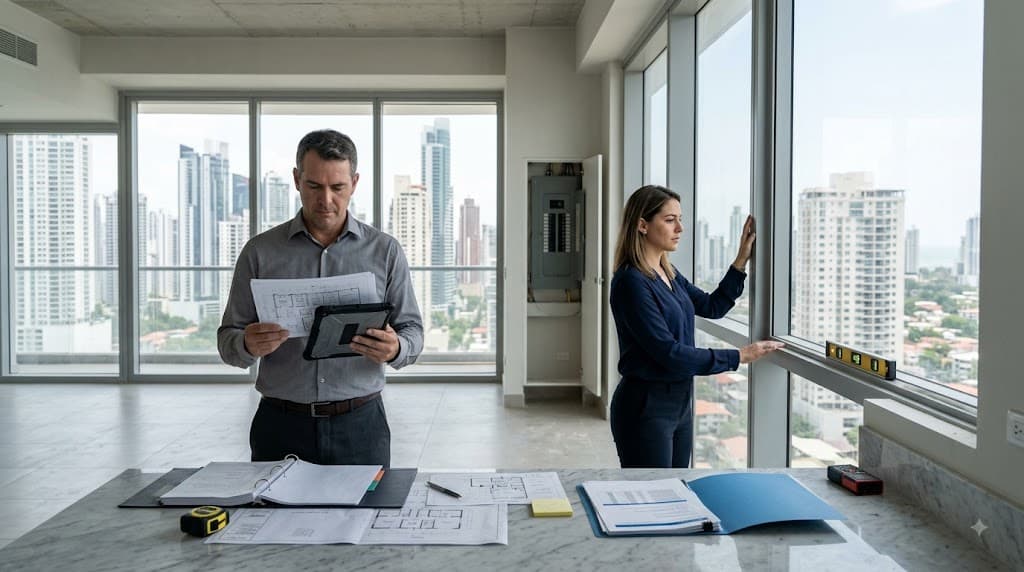
Property due diligence: the sequence outlined in the article
- Define your purpose
Living in the property, renting it out and preserving capital call for different selection criteria.
- Verify the legal information
Check the owner, encumbrances and the status of the documents, rather than relying on a presentation.
- Research the developer
Examine the developer’s track record and completed projects.
- Inspect the apartment and building
Assess the building’s condition, common areas and management alongside the apartment itself.
- Compare the price with the actual property
Compare features and expenses, not just the price per square meter.
- Think through a future sale
Before buying, understand who might want the property in the future.
A polished project presentation does not tell you whether a property is a good purchase. The renderings may be excellent, the apartment spacious and the price seemingly reasonable. But before recommending a property to a client, we need to understand something quite different: exactly what they are buying and how well it serves their purpose.
Sometimes, after a review, a property that looked promising at the first meeting is no longer appealing. That is a perfectly valid outcome. Our job is not to get a client to complete a purchase at any cost. It is to spot in advance the things that cannot be changed after buying.
First, we establish why the property is being bought
The same apartment cannot be equally suitable for everyone.
For a family with children, the school, daily commute, room sizes, neighborhood amenities and comfort over the next several years all matter. An investor is more concerned with rental demand, the number of competing listings in the building, the type of prospective tenant and the ability to sell later. If the property is also being purchased to obtain residency, there is another consideration: the transaction must be structured to meet the requirements of the chosen program.
So the first question is not “What kind of apartment do you want?” but “What does this apartment need to do for you?”
Only then does it make sense to compare specific developments.
We check the property in the registry, not just in the presentation
When considering a completed property, it is necessary to establish who owns it and what appears on its registry record.
In Panama, information about real estate and properties governed by the Propiedad Horizontal regime can be checked through Registro Público’s registration services. The system provides information on registered properties and access to the registration documents relating to them.
For a buyer, this is a fundamental distinction. A seller’s assurance that “all the paperwork is in order” does not replace an independent check.
With a new development, the focus shifts to the project documents, the contractual structure and the company assuming obligations toward the buyer.
We examine the developer separately
A beautiful development may be a company’s first project. Or its tenth.
We look at the developer’s history, completed projects, delivery timelines and how the buildings look several years after being handed over to their owners. It is especially useful to look beyond advertising for a new project and visit an earlier building by the same developer.
There is another source of information worth considering. Acodeco publishes data on complaints from property buyers. According to the agency, common grounds for complaints against companies in the sector include disputed contract terms, refunds, insufficient information, hidden defects and breaches of contractual obligations.
A complaint alone does not mean a company should be ruled out. The scale of its business also matters. But its history of dealing with buyers is information worth considering before committing money.
We look at the entire building, not just the apartment
This is one of the most important parts of the review, especially in the resale market.
You can renovate an apartment perfectly, but you cannot replace all the building’s elevators or fix poor management on your own.
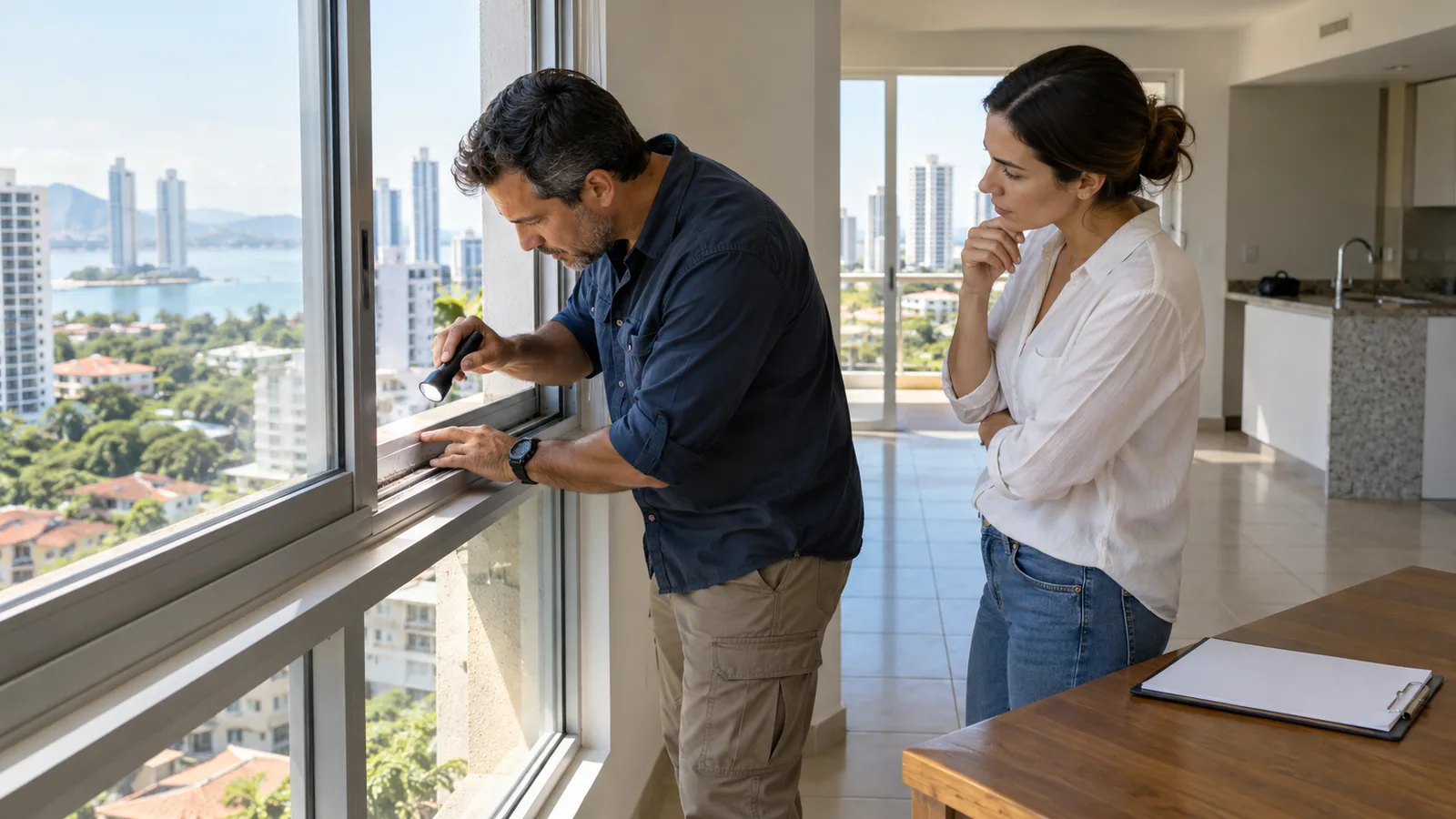
That is why we pay attention to common areas, parking, the façade, elevators, the pool, fitness facilities and service areas. We look at how carefully the property is maintained and whether the reality matches the listing photographs.
In Panamanian buildings governed by the Propiedad Horizontal regime, specific rules apply to the maintenance and management of common areas. The law also provides for co-ownership regulations defining owners’ rights and responsibilities.
We therefore want to understand not just the apartment itself but how the entire PH operates.
Sometimes a well-managed five-year-old building is more convincing than an almost-new development. Age alone tells you little without an understanding of maintenance quality.
We check whether the price reflects the actual property
We try to avoid calling anything “a good deal” before making comparisons.
First, we need to establish what comparable apartments cost in the same building and nearby developments. The properties must genuinely be similar in size, floor, condition, number of bedrooms, parking spaces, furnishings and view.
If an apartment is considerably cheaper than the others, our first response is to find out why, rather than celebrate.
Sometimes the seller really does need cash quickly. But there can be other explanations: an awkward layout, an unappealing view, the property’s condition, heavy competition within the building or other characteristics may explain the difference much better than the word “discount.”
The same applies in reverse. An attractive interior does not always justify a substantial premium, especially if a future buyer is unwilling to pay extra for the previous owner’s design choices.
We think about selling before buying
It may sound strange when a client is only beginning to choose an apartment. Yet one of the most useful questions is: who could buy this property in a few years?
The clearer we are about the potential future buyers, the more comfortable we feel about the property.
A good layout, a sought-after size, a convenient location and a building in sound condition usually offer more options than a property built around a single eye-catching feature.
An enormous terrace or unusual architecture, for example, may strongly appeal to a particular buyer. But if those features come at a substantial premium, it is worth considering whether someone else with the same priorities will be there in a few years.
Resale appeal rarely looks impressive in a rendering. Yet it becomes crucial when an owner decides to change their plans.
Only then do we decide whether to show the property to the client
We do not consider it good practice to send clients dozens of presentations and say, “Choose whichever you like.”
The work begins earlier. We need to understand the objective, visit the neighborhood, examine the property, check the documents, assess the developer or the condition of the completed building, compare the price and consider two future scenarios: using the property and eventually selling it. Sometimes this analysis leaves three options out of ten. That is much more useful to a client than a large catalog.
If these questions cannot be answered properly, a beautiful view from the window is not enough.
Buying property does not begin with a reservation. It begins with due diligence.
With best wishes, Liliya Soboleva!
Be Happy Now!