A Family Day in Panama City: School, Travel, Shopping and Everyday Logistics
An ordinary family day in Panama City: the school run, traffic, after-school activities, shopping, cars and choosing a neighborhood that works for you.
 Liliya SobolevaFirst published: August 28, 2026Updated October 17, 20269 min read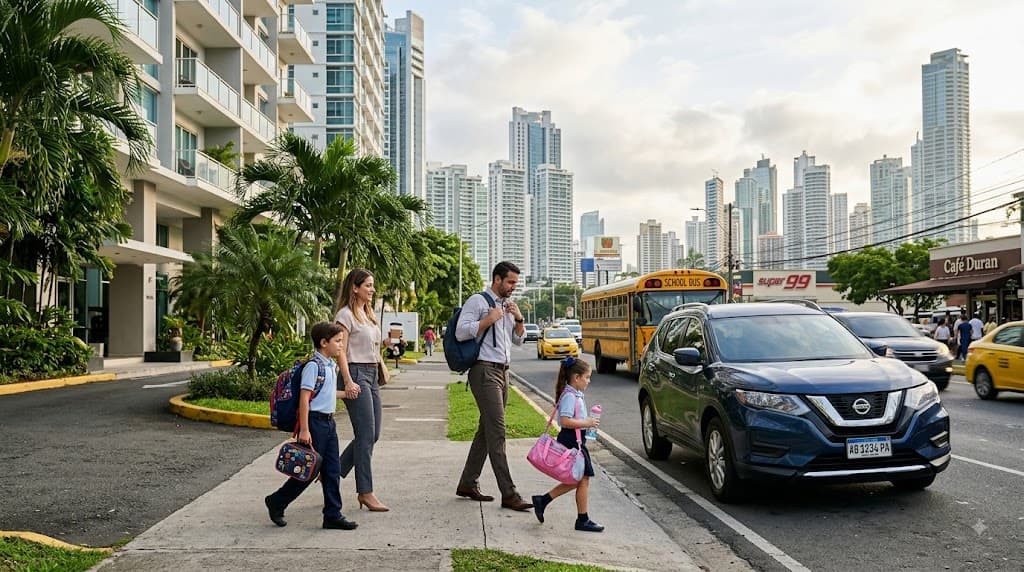
Put the neighborhood to the test on an ordinary weekday
The times below belong to the illustrative family scenario in the article. They offer a way to test routes, rather than a particular family’s actual timetable.
| Moment in the article | Everyday task | Question to ask about a future home |
|---|---|---|
| 6:30 — getting ready | Leave the apartment and reach the car | How convenient are the elevator, parking and exit from the building? |
| 7:00 — school | Drop off the children and continue your journey | How does the school fit with the neighborhood and workplace? |
| 12:30 — a forgotten backpack | Return home outside the usual route | How difficult does an unplanned trip home become? |
| 15:00 — after school | Coordinate the children’s activities and the parents’ errands | Who handles the second journey, and how? |
| 17:30 — shopping | Pick up groceries on the way | Does the shop fit into an existing route? |
| 18:30 — evening | Go for a walk and bring the day to a relaxed close | Is there a suitable place to walk nearby? |
When a family chooses an apartment in Panama City, the conversation almost always begins with the neighborhood, the view and the number of bedrooms. A few months after moving, however, other things become more important: what time everyone needs to leave in the morning, how long the school run takes, where to buy groceries after work and whether every child's activity will mean crossing half the city.
That is why Panama City is better assessed through the shape of an ordinary Tuesday than through a map of its neighborhoods.
Imagine a family with two school-age children. One parent works from home; the other goes to an office several times a week. The children attend a private school. After school, one has sports and the other has additional classes. The family lives in a modern apartment, uses a car and does not want every day to revolve around long journeys.
On paper, it is a fairly simple situation. In practice, it is precisely what determines whether an apartment is truly convenient.
6:30. The morning does not begin with the ocean view
A panoramic view is particularly impressive during a viewing. On an ordinary weekday, a family soon notices something else: how long it takes everyone to get ready and leave the building. Are there two parking spaces? How quickly does the elevator run in the morning? Is it easy to get out of the parking garage? Do you immediately join a busy city street?
For a family with children, these are not minor details.
If the school is relatively close, the morning is calm. If several neighborhoods lie between home and school, a small difference on the map can become a daily dependence on traffic conditions. When selecting a home, we therefore look beyond the distance in kilometers. It is much more useful to picture the actual route at roughly the time the family will use it. An apartment may be only a few kilometers from school and still be inconvenient in the morning.
7:00. The school effectively determines where you live
For a family with children, choosing a school should often come before choosing an apartment.
Panama City has many private and international schools, but they are spread across different parts of the city. If you buy a home first and choose a school afterward, you may discover that twice a day you have to travel through neighborhoods you never intended to include in your routine.
This becomes especially noticeable with several children. One child's school, another's sports, the parents' workplace and home can be four entirely separate points. A beautiful apartment can then demand too much travel time. A good family location is therefore not necessarily the neighborhood with the most expensive property. It is a neighborhood that makes it easy to reach the places your family uses every day. For some, that means Costa del Este. For others, it means San Francisco, Santa Maria or the city center. The answer depends on a particular schedule, not a neighborhood ranking.
8:00. After the school drop-off, the city looks different
Once the children are in class, the parents' own day begins.
The differences between neighborhoods become apparent again.
If one parent works from home, the apartment's surroundings suddenly matter just as much as the apartment itself. Is there a café for a meeting? Can you walk quickly to a supermarket? Is there a pleasant place for a stroll? Do you need to get in the car even for a coffee or a trip to the pharmacy? Santa Maria offers a quieter, more enclosed setting, but driving becomes a natural part of most journeys.
Costa del Este has many services within the neighborhood, although distances between individual destinations can still be considerable. In central areas such as San Francisco or Bella Vista, many errands can be combined into a single drive or walk, in exchange for a denser urban setting. What suits someone living alone can feel very different to a family of four.
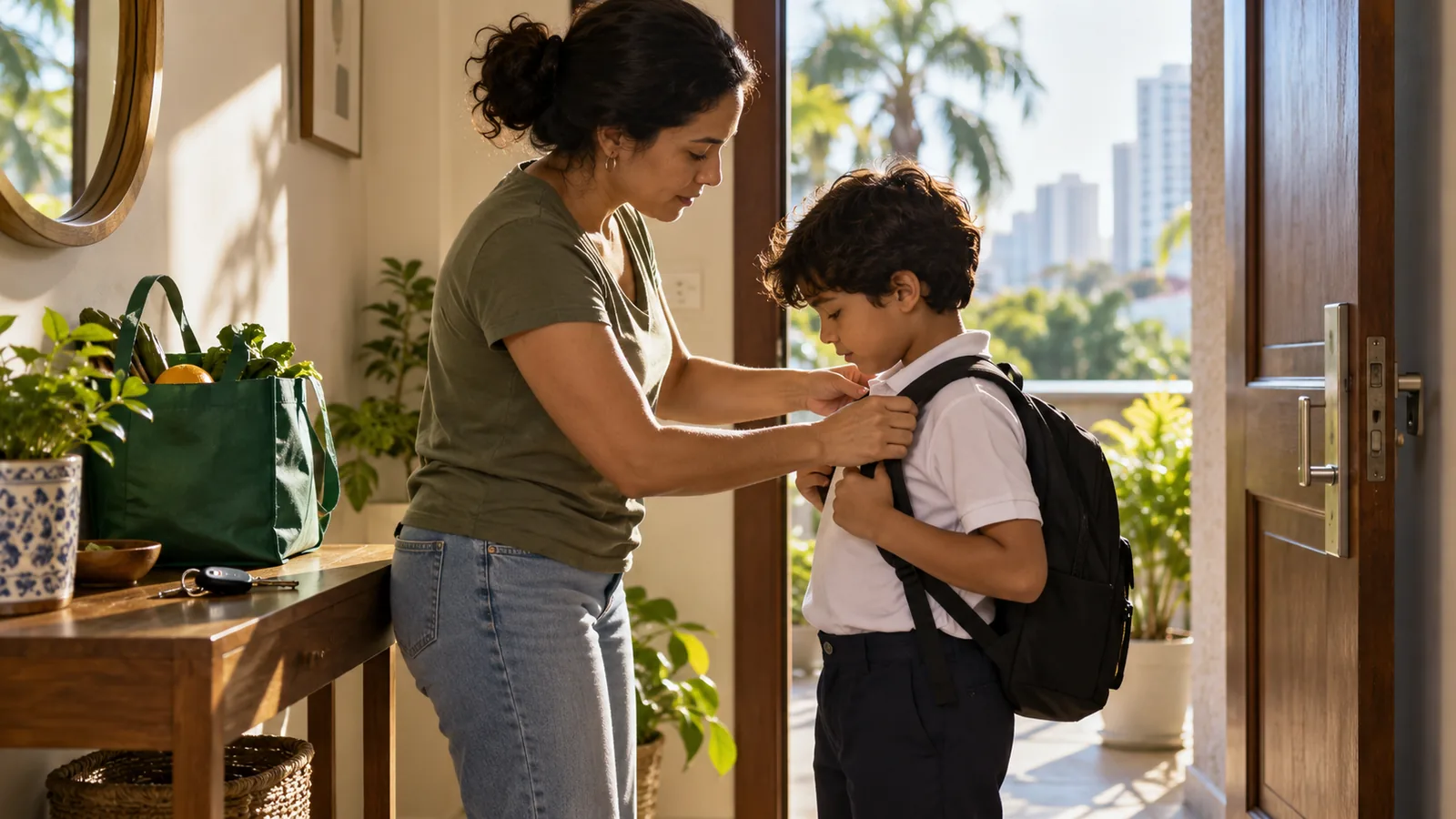
12:30. A forgotten school backpack quickly puts the neighborhood to the test
There is a very simple way to understand family travel in a city: imagine that a child has left their sports kit at home.
If the apartment, school and office form a convenient route, the situation is inconvenient but manageable.
If the family lives on the other side of the city, that small oversight can consume a significant part of the day.
These are the moments that make up real life after moving. They rarely come up when buying property because it is much more pleasant to discuss the pool, gym and apartment size.
But a family uses the pool a few times a week. It uses the route to school twice every weekday.
In the long run, the latter usually matters more.
15:00. After school comes the second round of driving
A family's day does not end with the last lesson.
One child needs to get to soccer, swimming, tennis, dance or extra classes. Another needs to go somewhere else. Sometimes the parents can share the journeys; sometimes the entire route falls to one person.
This is when it becomes particularly clear why a “central location” guarantees little on its own.
What matters is proximity to your own map of the city, rather than to Panama City's geographical center.
If school, sports and home are in the same area, even a busy schedule remains manageable.
If every destination requires a separate journey across the city, the family gradually starts either changing activities or reconsidering where it lives.
This is often precisely why people choose a different apartment after their first year in Panama.
They know the city by then and stop choosing a property from photographs. They choose it around their schedule.
17:30. The supermarket is part of the route, not a separate outing
Shopping in Panama City also depends heavily on your way of life.
A large family usually combines several approaches. The main groceries are bought once or twice a week, extra items are picked up near home, and certain products are ordered for delivery.
Here again, the neighborhood affects how much time is needed.
If a good supermarket is on the way home from school, grocery shopping hardly feels like a separate task.
If it requires an additional journey every time, the burden of everyday errands gradually grows.
When choosing a home, it is therefore useful to look beyond whether a shop is “nearby.” What matters is whether it lies on the family's natural route.
The difference seems small until you repeat the same journey a hundred times in a year.
18:30. The evening reveals how convenient the neighborhood really is
After work and school, the family finally returns home.
Then comes a question that is almost impossible to answer from a residential development's presentation: what can you do if you do not want to drive anywhere else today?
Can you go out for a walk? Is there a park or waterfront promenade? Can you walk somewhere nearby for dinner? Is there a place for a child to spend time outdoors?
Costa del Este has its own facilities and Paseo del Mar. In San Francisco, Parque Omar is a major advantage. On Avenida Balboa, it is the Cinta Costera. In Santa Maria, the enclosed, green surroundings create a very different kind of evening.
For a family, this can matter more than the number of amenities inside the building.
A large, attractive pool is a pleasure. But a neighborhood where an ordinary evening outside the apartment is enjoyable brings benefits every day.
One car or two is also part of choosing an apartment
This question rarely appears in a property advertisement, even though it is fundamental for a family.
If both parents travel separately and the children have different schedules, a second car can make life noticeably easier.
That immediately raises another question: how many parking spaces come with the apartment? For a large apartment, a single space can be a serious practical limitation. An additional space may need to be rented separately, if one is available in the building at all.
If the family wants to manage with one car, the home's location becomes even more important. You need to know whether one parent can handle some errands on foot or by taxi while the other has the car.
Transport and property cannot therefore be considered separately. They function together.
Delivery helps, but cannot make an inconvenient location convenient. Panama City offers many delivery services, taxis and home services. These make everyday life considerably easier. You can order groceries, meals or medicines, or book a car through an app.
But the entire choice of neighborhood should not rest on the idea that “if necessary, everything can be delivered.”
Delivery is excellent for occasional tasks. It is less effective at overcoming inconvenient daily distances. If the children go to school far from home every day, no app will give the family back the time spent traveling.
What families usually learn after the first three months
After a few months in Panama, attitudes toward property become much more practical. The view is still appealing. The pool remains a pleasant bonus. But the apartment's main strengths suddenly become an easy way out of the building, two parking spaces, a good supermarket on the way home and a school within reasonable reach.
Conversely, what seemed a minor inconvenience during a viewing can become irritating every day. For families who do not yet know Panama City well, it can therefore be wiser to rent first.
A few months give you the chance to test your own routine: where you actually spend time, how often you travel to particular neighborhoods and what distances feel comfortable.
After that, buying a property becomes a much more informed decision.
A good neighborhood saves time
When comparing two apartments, attention naturally turns to price, size and the condition of the building. For a family, however, another resource becomes very noticeable soon after moving: time.
An extra half-hour on the road in the morning and another half-hour in the evening add up to roughly five hours each working week. That is why a slightly smaller apartment in the right part of the city can sometimes offer a family more than a spacious property far from all its daily routes.
In Panama City, a good family neighborhood is not one where everything is nearby. It is one where the things your family uses every day are nearby.
With best wishes, Liliya Soboleva!
Be Happy Now!